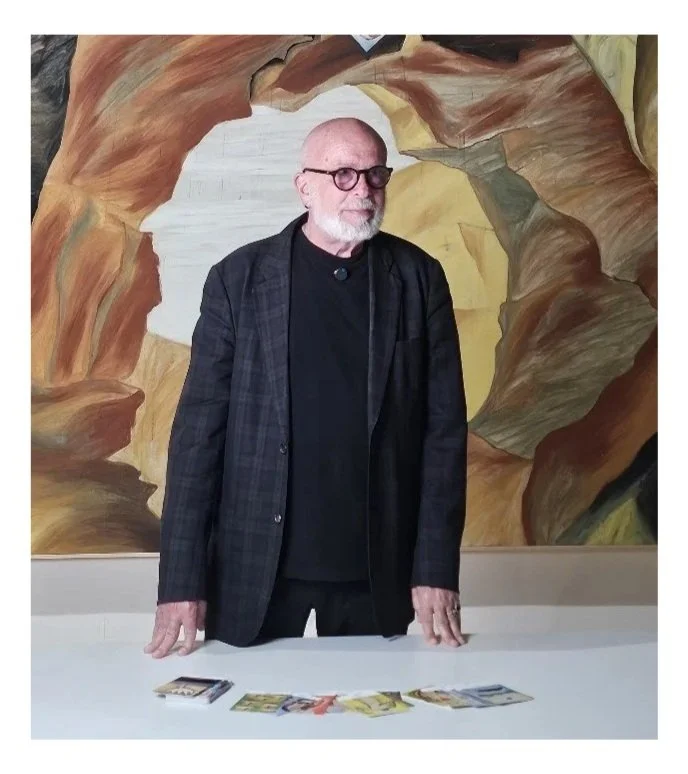
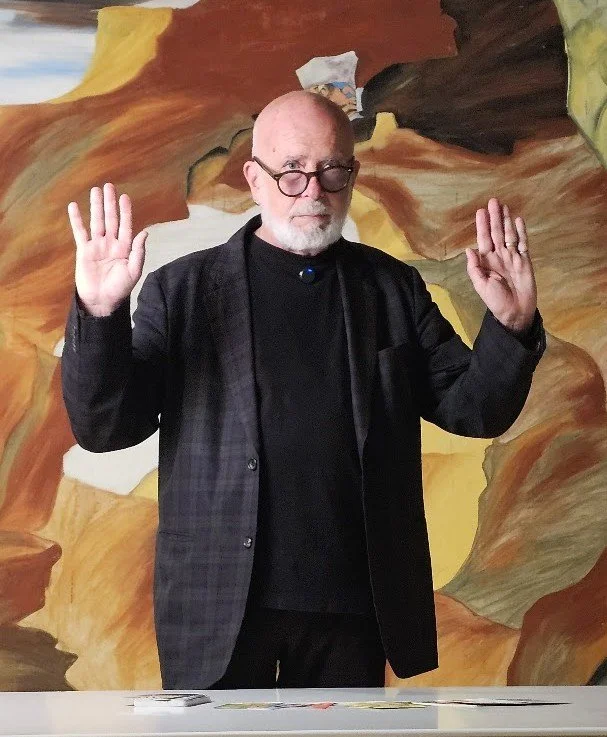
An interview with Francesco Clemente
Francesco Clemente is one of the most influential contemporary painters of his generation. Born in Naples, his work has long developed across different geographies — from Italy to New York, and especially India, which has profoundly shaped his visual language and philosophical outlook. Since the late 1970s, Clemente has explored themes of identity, spirituality, transformation, and the body through painting, drawing, and works on paper. Deeply influenced by Indian culture, miniature painting, and Hindu and Buddhist thought, his work unfolds as a continuous journey between inner and outer worlds, where symbols, archetypes, and personal imagery merge into a fluid, poetic system.
Art on Cards
Your deck for Art on Cards translates your visual universe into a portable and interactive form. What interested you in working within this structure?
Francesco Clemente
I believe in fragmentation. It doesn’t trouble me to encounter the void—the gap between one moment in life and the next. The cards are also that, in a way: fragments, separate moments that remain open. Together, they can become a necklace, or a rosary—a mala made of images.
What interested me was precisely this possibility of reducing an image to a single unit without fixing its meaning. A card is not a finished statement. It acquires meaning through its relationship with the other cards and with the person looking at it. This is very close to the way I think about painting: never fixed, always shifting, always in transformation.
In India, I learned to think of images as part of a continuous flow rather than as isolated objects. The cards allow that flow to remain alive.
Art on Cards
Many of the cards evoke symbolic systems—almost a personal cosmology, or even a form of tarot. I’m thinking of Person, Mirror and Secret, but also Star, Moon and Rebirth. How do these images relate to your long-standing interest in spirituality and Indian philosophy?
Francesco Clemente
All these images come from a group of paintings originally titled Emblems of Transformation, so there is certainly a connection. The word transformation is very important to me. An emblem is a kind of talisman, but it can also be a passport. I think of these images as passports to transformation.
They are not meant to illustrate a fixed system, but perhaps to suggest one. In some traditions in India, identity is not something stable. It unfolds, reflects itself, dissolves and takes form again.
A card like Mirror speaks about reflection and multiplicity. Secret suggests something hidden at the centre of being. Star and Moon relate to orientation, cycles and time, and to the relationship between the individual and the cosmos. Rebirth expresses the idea that nothing remains fixed and that everything is constantly becoming something else.
For me, these are not symbols to decode. They are spaces to enter.
Art on Cards
What do you imagine happens when people begin to use and combine the cards?
Francesco Clemente
I imagine they begin to create their own narratives. The cards are like a language without a fixed grammar—or rather, a language whose grammar each person has to invent.
When you place Chain next to Surrender, or Love next to Sacrifice, a meaning begins to emerge, but it is not given in advance. It belongs to the person making the connection.
I believe in experience rather than authority, and I don’t want to impose an idea on anyone. The greatest miracle is to have a thought of your own. Certain philosophical traditions in India also understand knowledge in this way: not as a fixed doctrine transmitted from above, but as something that emerges through experience, association and intuition.
My hope is that, by moving through the deck and encountering its infinite variety of combinations, people may open themselves a little more to life itself. The cards are not simply objects to be understood. They are something to experience.