
How Art on Cards Was Born
Bartolomeo Pietromarchi
Founder and Artistic Director, Art on Cards
I have spent much of my professional life inside museums, working with artists and thinking about the conditions in which an encounter with art becomes possible. Over time, one question returned with increasing urgency: how can contemporary art come closer to people without being simplified, explained away or turned into a spectacle?
Art on Cards was born from that question. I did not want to invent another device for communicating art from the outside. I wanted to create a form generated from within an artist's own language: an object that could be held, shuffled, drawn, placed on a table, passed from one person to another, contemplated alone or activated collectively. Developed in strictly collaboration with the artists the result is at once an artwork, an editorial project and a tool for interpretation, conversation and play. Each edition begins with a direct dialogue, and each artist changes the rules of the game.
A portable museum
One of the project's first points of reference was Marcel Duchamp's Boîte-en-valise. By condensing reproductions of his work into a suitcase, Duchamp imagined what has often been described as a portable museum. What interests me in that gesture is not miniaturisation for its own sake, and certainly not the transformation of art into a souvenir. It is the possibility that an artistic universe can migrate: that it can leave the architecture and authority of the museum without losing its density.
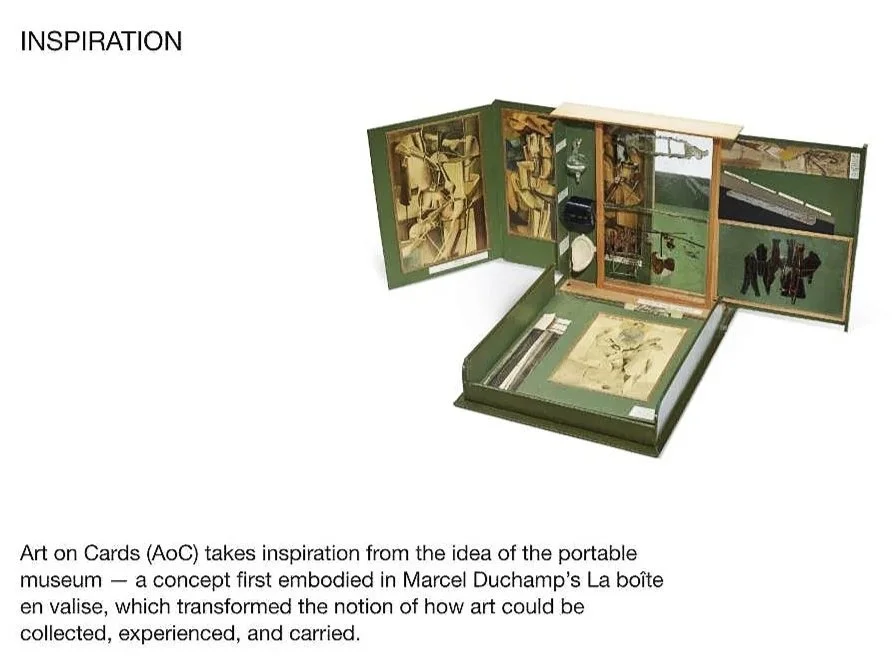
Each Art on Cards deck is conceived as a micro-museum, but also as something more unstable and alive than an archive. The cards do not simply preserve a sequence of images. They allow those images to enter into new relationships. A deck can be observed, collected and studied, but it can also be used. Once it is used, the order changes, unexpected proximities emerge and the player becomes an interpreter - not replacing the artist, but entering the field of meanings that the artist has opened.
This distinction is essential. Art on Cards is not a predictive instrument, a form of divination or a conventional game of chance. It does not tell us what will happen. It creates a temporary space in which memory, association, imagination and thought can happen differently.
Language games and the truth of play
The deepest philosophical source of Art on Cards is Ludwig Wittgenstein's idea of language games. In Philosophical Investigations, Wittgenstein introduces the term to describe language together with the activities in which it operates. Language is never an abstract system detached from life. As he writes, "the speaking of language is part of an activity, or of a form of life". Later, he offers the formulation that has become fundamental to the project: "the meaning of a word is its use in the language".
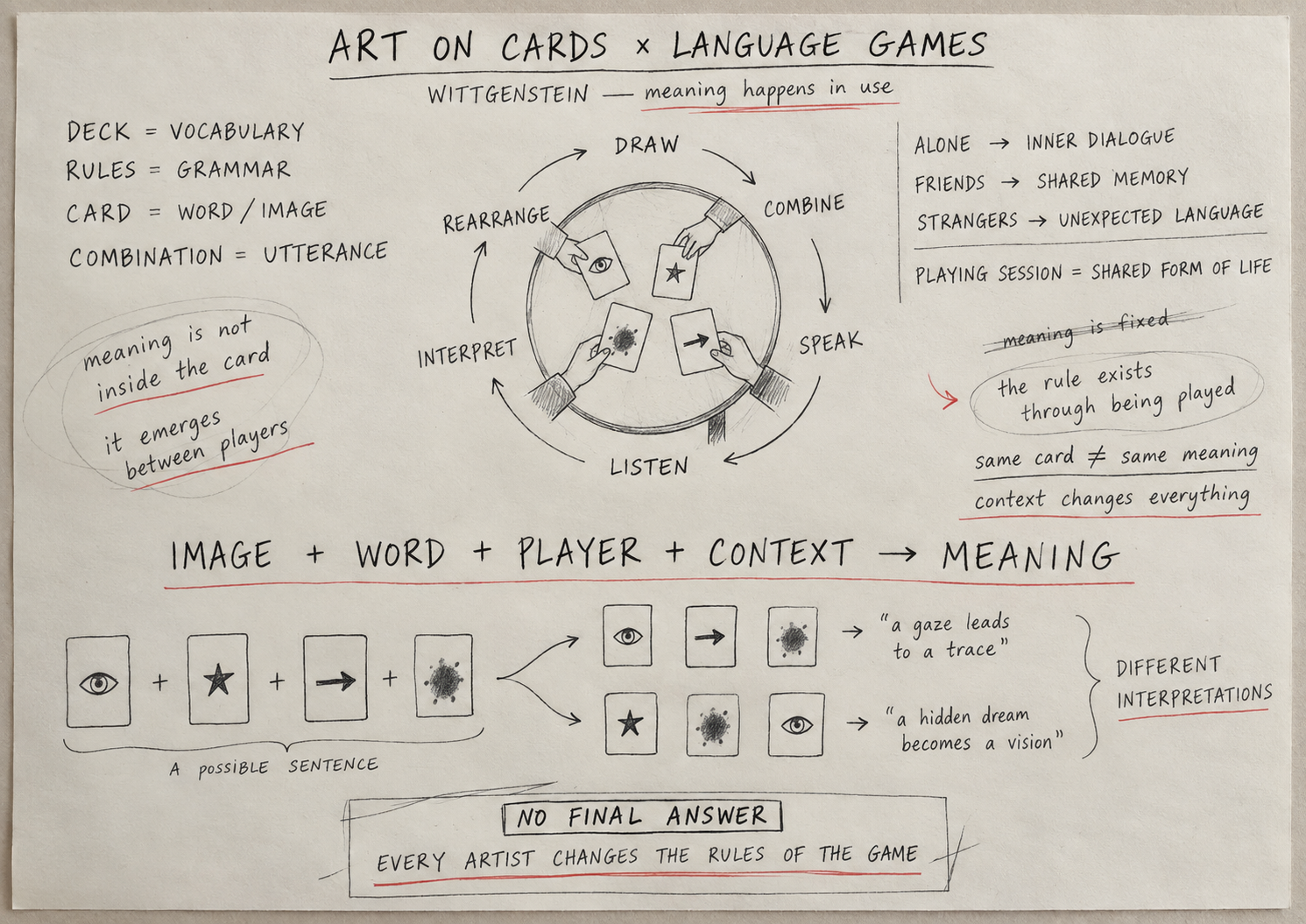
For Art on Cards, this means that meaning is not a fixed content hidden inside a word or an image, waiting to be decoded correctly. Meaning emerges through use, context, sequence, gesture and relation. A card acquires a different force according to the cards placed beside it, the person who chooses it, the sentence in which it appears and the response it provokes in the other players. The same image can become intimate, ironic, political, painful or visionary without ceasing to belong to the artist's world.
Wittgenstein's discussion of games is equally important. He asks us not to search for one essence shared by every activity called a game, but to notice a network of overlapping affinities - family resemblances. Art on Cards follows this non-essentialist structure. There is no single mechanism that must govern every deck. There is a shared spirit, but no closed formula. The language of each artist generates a different form of play.
In the book Wittgenstein offers an image that feels almost like a description of the project's method: people are playing with a ball in a field, beginning one game, continuing with another and altering the rules as they proceed. The change does not necessarily destroy the game. The players can still recognise its spirit. One of the rules of Art on Cards is therefore that the rules may be adjusted at will, provided their spirit is not betrayed. The instructions are indicative, partial and open. They establish a common ground, not a prison.
For me, play is the activity that allows us to lower our defences and feel safe - and perhaps, in that condition, to listen to another person and think through the other. Outside play there is only competition, conflict, resentment and greed. This does not mean that a game cannot contain rivalry. It means that rivalry is held within a freely accepted form and does not exhaust the relationship between the players.
True play is free and gratuitous. It has no justification outside itself. The moment it becomes compulsory, instrumental or entirely subordinated to winning, it loses its deepest character. In genuine play, one accepts a rule while remaining aware that the rule could have been otherwise. This combination of discipline and freedom is also one of the conditions of artistic experience.
Play, in this sense, is not an escape from truth. It is what reveals truth. By lowering our defences, it forces us to look inside ourselves. A choice made quickly, an association that unexpectedly surfaces, an image that attracts or repels us: these gestures disclose something before we can organise it into a respectable explanation. The game makes room for an unguarded form of self-recognition.
Word and image
This is why words and images have equal importance in Art on Cards. The word is powerful, but it is also vulnerable to vanity: we use language to display control, intelligence, identity and authority. The image interrupts this narcissism of the word. It does not allow meaning to remain entirely under our command. It reaches memory and emotion before discourse has fully organised them.
At the same time, the image is not an illustration and the word is not its caption. Neither is asked to explain the other. Their encounter produces a third space, where what is visible and what can be said remain in tension. The player moves between them, composing a sentence or a constellation whose meaning is personal but never purely private, because it must be placed before others and shared.
The transformation of art into a deck resembles what happens in the rear-view mirror of a car: things appear smaller than they are, but not less real. Scale is reduced; intensity is not. The object fits into the hands, while the questions it carries may remain larger than the player.
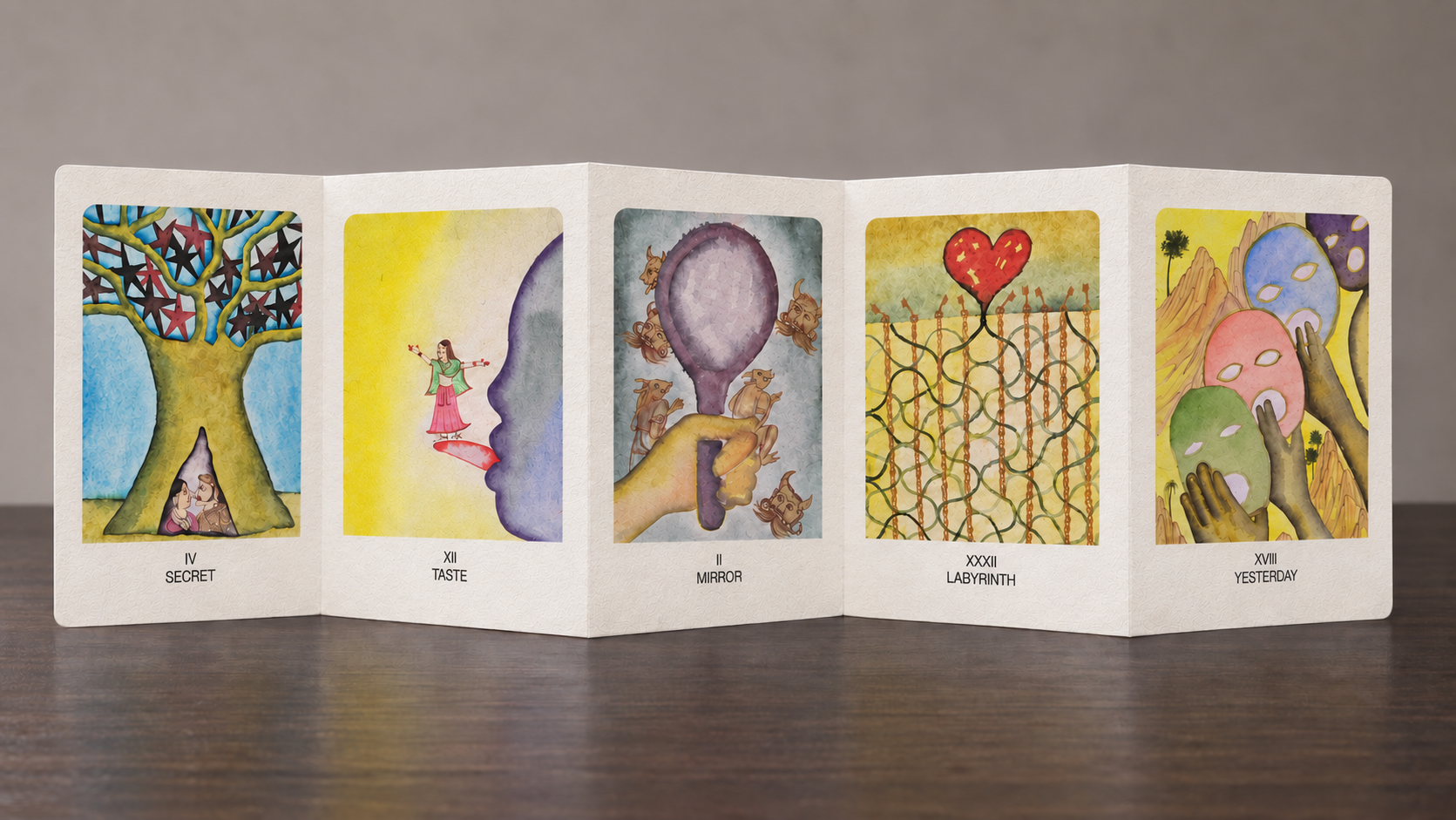
Art on Cards Leporello by Francesco Clemente
Two artist worlds
Francesco Clemente was the first artist with whom this idea took concrete form. His work was a natural point of departure because it already moves like a nomadic language. Across Italy, India and the United States, and across painting, drawing and poetry, Clemente has developed an open vocabulary of the body, autobiography, myth, spirituality, symbols, desire and memory. His images do not belong to a single geography or doctrine; they travel, absorb and transform.
The inaugural deck does not attempt to summarise or explain Clemente. It creates a portable poetic grammar from within his universe. Images and words - love, star, sacrifice, prophet, among others - become coordinates that can be combined and recombined. When a player brings them together, the result is simultaneously a new path through Clemente's work and a provisional portrait of the player. To play with the deck is not to master its symbols, but to allow them to act upon one another and upon us.
The second project, developed with Shirin Neshat, demonstrates why Art on Cards cannot become a fixed template. Neshat's work is structured by powerful tensions: body and language, voice and silence, individual and collective experience, intimacy and politics, faith and power, exile and belonging. In works such as Women of Allah, Rapture and The Book of Kings, the written word does not simply accompany the image. It enters the body, divides the visual field and makes silence legible.
Concepts such as evidence, desire and speechlessness open a different game from Clemente's. Where Clemente's deck proceeds through nomadic constellations and symbolic affinities, Neshat's asks the player to inhabit contrast, distance and unresolved polarity. The aim is not to solve those tensions but to experience how meaning is produced between them. The first two collaborations thus establish the essential principle of the platform: every artist brings not only new images, but a new grammar and a new set of possible rules.
Crowdfunding as a founding gesture
The decision to launch Art on Cards through crowdfunding follows the same logic. It is, of course, a way to make production possible, but it is not merely a financial technique or an advance-sale mechanism. A participatory project should also be founded through participation. Crowdfunding allows a community to gather around the idea before the project is complete and to take part in the conditions of its existence.
Support for the Limited Editions and founding rewards helps bring the standard editions into production, but it also sustains the educational life of Art on Cards: playing sessions, workshops, seminars and public conversations in schools, universities, museums and cultural institutions, as well as Museum Editions intended to circulate where access matters most. The purpose is not only to place an object in the hands of collectors. It is to create situations in which people can use it together.
Crowdfunding is therefore also a test of trust. It asks whether an artistic and curatorial idea can generate a founding community rather than simply a market. Those who support the project are not buying visibility from the outside; they are helping to make a shared possibility real.
An open form
Art on Cards will continue to change with every artist. Its identity does not lie in repeating one successful set of rules, but in preserving a space in which rules can be reinvented without betraying the spirit of the game. The task is not to make contemporary art easy. It is to make the encounter with it active, intimate and collective.
A deck is small enough to travel and serious enough to alter a conversation. It can become a portable museum, a language game and a form of life shared for the duration of play. In Art on Cards, things may appear smaller than they are - but never less real.